Lately, people have been showing growing interest in natural skincare ingredients. Many want simpler routines that avoid harsh chemicals and unnecessary steps. And naturally, olive oil often sits at the center of at-home skincare debates.
Some people use it for hydration and glow, while others avoid it due to breakouts or irritation. But the bigger question is: Is olive oil good for the skin? And what all could use it for? In this post, I explore whether olive oil is good for your skin, how it works, and when it helps or harms your skin barrier.
This conversation connects to my episode “Ep. 122 – Making Olive Oil Sexy with Fancy Peasant Founder Anastasia Ganias,” where we discussed olive oil as more than food. We explored how Mediterranean living shapes daily wellness habits, including beauty and skincare rituals. Interested in implementing this practice yourself? Then keep reading!
Is Olive Oil Good for Your Skin? Understanding This Wellness Hack
More people are now shifting toward natural skincare while trying to avoid clogged pores, irritation, and expensive routines. Olive oil can definitely support some skin types, especially dry skin, but it doesn’t suit everyone. Your skin type, application method, and oil quality all determine whether olive oil helps or harms your skin barrier. This transparency is important!
As with anything, you should always patch test olive oil before full use. Some skin types respond well, while others develop clogged pores or sensitivity. Skin reacts differently depending on oil production, barrier strength, and overall routine.
And you don’t have to do this alone. Below, I’ll discuss what olive oil is, how it can benefit the skin, and how to intentionally incorporate it into your routine. With this guide, you can better support a holistic, naturally supportive wellness regimen that works with you.
What Is Olive Oil?
Olive oil is a natural liquid extracted from pressing whole olives, predominantly in Mediterranean regions like Greece, Italy, and Spain. It’s been a common household staple forever, beloved for cooking, skin and hair care, and even as home remedies passed down through families.
A lot of people like using it on dry skin because it feels rich and soft straight away. Sometimes people dab a little onto dry patches or mix it into really simple skincare routines at home. Other people try it once and immediately decide it’s too heavy. Everyone’s skin is different!
And that’s why opinions on olive oil are all over the place. Some skin types love it, while some absolutely do not. It really depends on what your skin naturally reacts well to.
As we look at whether olive oil suits different skin types, it also highlights how unique personal wellness really is. In “Ep. 104 – Celebrating 2 Years of The Cinnamon Effect,” I shared how small aligned choices shape long-term wellbeing. Skincare works in a similar way, where consistency matters more than complex routines or perfect products.
Is Olive Oil Good for the Skin?
People usually try olive oil on their skin because it feels rich and moisturizing. It contains natural fatty acid content, vitamin E, and anti-inflammatory properties, which is why it’s been part of skincare routines for generations. In Mediterranean households specifically, it’s one of those ingredients people have always kept around. Beyond this, many find it great for treating a variety of skin conditions.
How people use olive oil beyond the kitchen differs, though. A lot of people use it on dry patches because the skin just drinks it up. But other people try it once and never use it again. It can feel oily, heavy, or a bit too much depending on your skin type. That’s the tricky thing with skincare. Something can work amazingly for one person and not suit someone else at all.
After exploring how olive oil works in skincare, it is worth looking at how ingredients connect to lifestyle. This concept heavily applies to my episode, “The Truth About Clean Beauty with Crunchi Founders Kelly Kreusler & Melanie Petschke.” In it, I sat with Kelly and Melanie to discuss what clean beauty actually means, and why it’s important to question the ingredients and common skincare products.
And if you’re interested in learning about even more naturally beneficial products, listen to my episode with holistic and biological dentist, Dr. Ilona Fotek! Together, we discuss the role coconut oil can have in your oral care routine.
Is Olive Oil Comedogenic?
Olive oil is generally considered moderately comedogenic, so it can clog pores for some people. This is particularly true if your skin is oily or breaks out easily, because it’s quite a rich, heavy oil. Some people use it and have no issues at all, and it leaves their skin feeling moisturized. Others notice little bumps or congestion pretty quickly. It really just depends on your skin, which varies from person to person.
When we talk about olive oil being comedogenic, individual responses become a key factor in outcomes. This connects to my episode with Alyssa Scarano, a licensed professional counselor and founder of The Collective Therapy & Wellness. While we discuss how awareness of patterns influences life, skin behaves similarly. It reacts differently depending on internal balance and external choices.
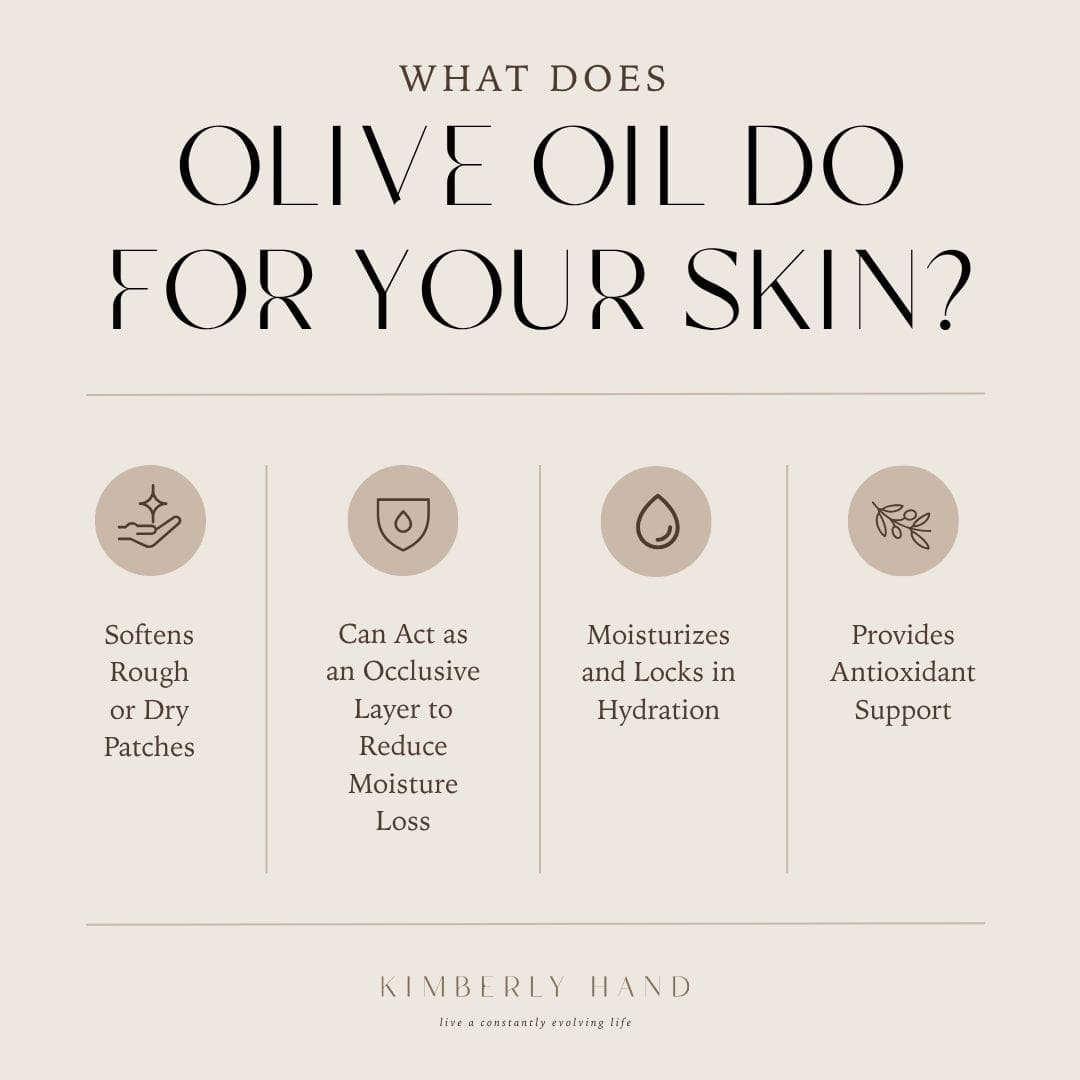
What Does Olive Oil Do for Your Skin?
Softens Rough or Dry Patches
Olive oil tends to get used on really dry areas like elbows, knees, hands, or flaky patches on the face. It soaks into the skin, gradually helping smooth and even out texture. You notice it most when the skin is quite dry to begin with. If it works for your skin, the effects are next level.
Can Act as an Occlusive Layer to Reduce Moisture Loss
Olive oil is excellent at forming a light layer on the skin that helps reduce moisture loss after moisturizer. That can be useful if your skin dries out easily during the day or overnight. But it is quite rich, and some people don’t love the heavier feel or how it sits on their skin.
Moisturizes and Locks in Hydration
Olive oil helps the skin hold onto moisture, especially when it feels dry or tight after cleansing. It’s something people usually reach for when their skin just feels a bit uncomfortable or stripped. Over time, it can really soften things up in a cleaner, more comfortable way.
Provides Antioxidant Support
Olive oil contains antioxidants, like vitamin E and squalene, that support the skin against everyday environmental stressors. This includes pollution, free radicals, UV radiation, and even extreme temperatures. This isn’t necessarily something you notice right away… It’s a subtle background benefit that gradually improves your barrier.
What Type of Olive Oil Is Best for Skin?
Refined Olive Oil
Refined olive oil is made from lower-quality virgin oil that is heated, steamed, or filtrated. Because it goes through additional processing, it’s stripped back compared to other options. It does feel lighter and smoother going on, which some people prefer for that reason alone. But you do lose some of the natural nutrients along the way, so it’s not usually the first choice for skincare use.
Cold-Pressed Olive Oil
Cold-pressed olive oil is extracted from fresh olives without the use of additional heat or chemicals. As a result, you get more of those natural properties that make it such a valuable staple. It still feels fairly rich, but a touch lighter than extra virgin. A lot of people lean toward this one when they want something natural but not too intense on the skin.
Extra Virgin Olive Oil
This is basically the most “whole” version you can get. Extra virgin olive oil comes from the first cold press, so it keeps more of its natural antioxidants and nutrients. On skin though… It’s rich. Some people love that, others find it just sits a bit heavy, especially if their skin is already on the oily or sensitive side.
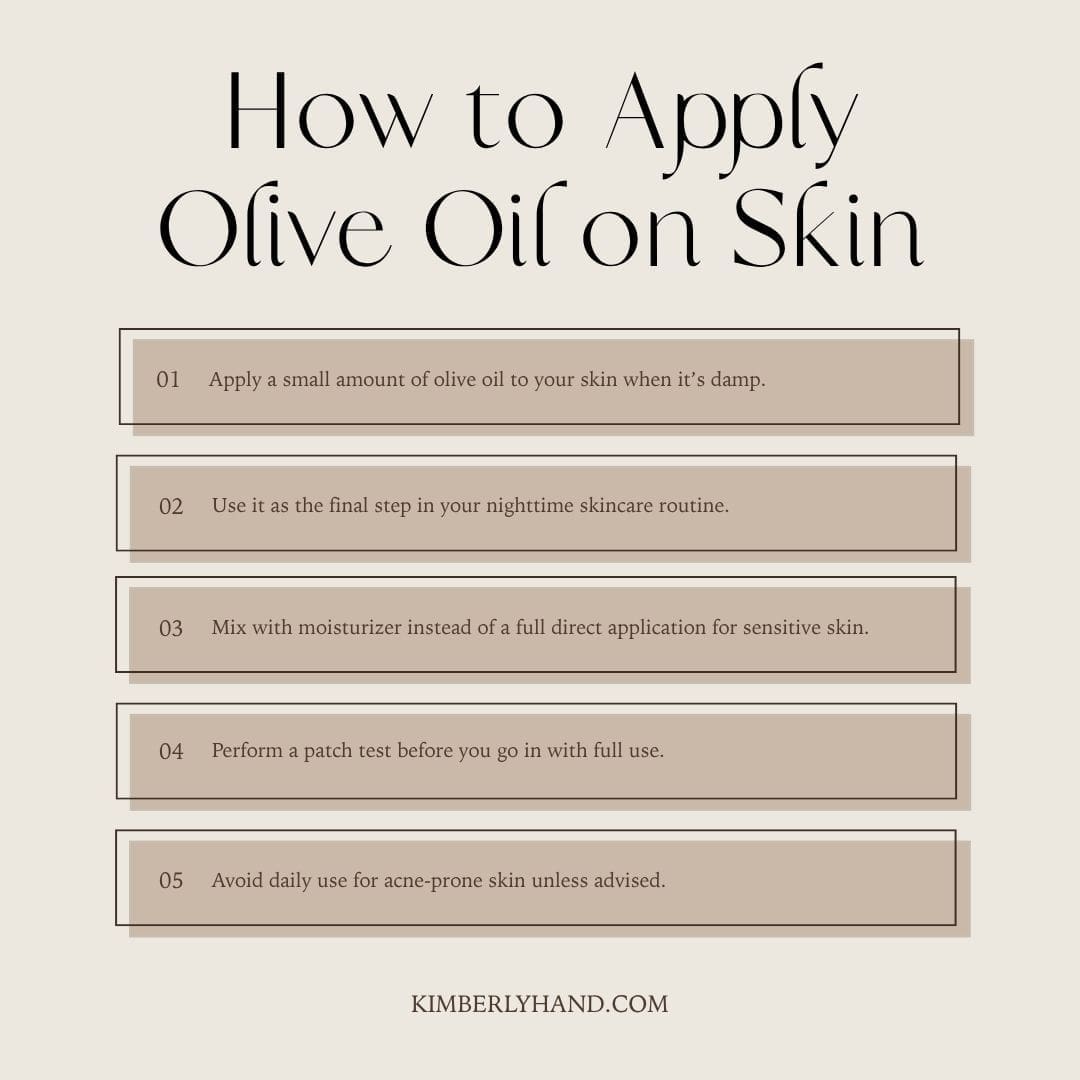
How to Apply Olive Oil on Skin
Apply a small amount of olive oil to your skin when it’s damp.
If you like the feel of oil on your skin but don’t like the heaviness it leaves behind, try applying it to damp skin. Olive oil tends to work best on skin that’s still a little damp after cleansing, because it spreads more easily and doesn’t sit as heavy. Dry skin can make it feel a bit too rich, so that tiny bit of moisture underneath really helps balance things out.
Honestly, you only need the smallest amount. People often use way more than necessary at first, but less really does feel better here. As you simplify skincare routines, it often helps to focus on habits rather than perfection or overthinking.
In “Ep. 61 – Finding Freedom and Joy Living Alcohol Free,” I explored how simplifying daily choices creates more ease and clarity. The same principle applies to skincare, where less complexity often leads to better awareness and results.
Use it as the final step in your nighttime skincare routine.
A lot of people like using olive oil at night as the very last step, almost like sealing everything in before bed. It kind of sits on top of the skin and helps hold in whatever you’ve already applied, which can feel really nice if your skin gets dry overnight.
It does feel richer than a normal moisturizer, though. Because of this, it’s more of a “some nights” thing for a lot of people rather than an everyday must. Still, when it works for you, it can leave your skin feeling quite soft and comforted in the morning.
Mix with moisturizer instead of a full direct application for sensitive skin.
If your skin is on the sensitive side, combining it with something else makes for a much gentler application. Mixing a drop or two into your regular moisturizer helps soften the oil’s richness, so it doesn’t feel as intense.
It’s a bit more forgiving like that, especially if you’re not sure how your skin will react yet. A lot of people find this middle-ground approach makes it easier to enjoy the benefits without that heavy feeling some oils can have.
Perform a patch test before you go in with full use.
Testing the product is one of those steps that’s easy to skip, but really worth doing. Just try a small amount on a little area of skin first and give it a day or two. Also, make sure to test it on a more inconspicuous area, like behind the ear or on the forearm!
Everyone’s skin responds differently, and olive oil can be either really nice or a bit too much depending on the person. Taking that extra moment upfront just gives you peace of mind before using it more widely.
Avoid daily use for acne-prone skin unless advised.
If your skin is acne-prone, it’s usually better to go slow with this one. Daily use can feel a bit heavy for some people and may lead to congestion, so it’s not something to rush into. That said, everyone’s skin is different, and some people tolerate it fine in small amounts. It’s just about paying attention to how your skin responds and keeping it occasional if that works better for you.
Olive oil can definitely support some skin types, especially dry skin, but it doesn’t suit everyone.
Olive oil can help with skin hydration, but it really just depends on your skin. Some people love it when their skin feels dry or tight because it kind of softens everything. Others may find it a bit too heavy, leading to congestion or clogged pores.
Skin care, ultimately, is entirely personal. Something that works beautifully for one person can feel completely off for someone else.
If you’re trying to be more intentional with skincare, it usually helps to keep things simple and just notice how your skin reacts over time instead of overthinking the routine too much. If you’re interested in learning more, make sure to visit my post on how to start a clean beauty routine! You can also listen to The Cinnamon Effect, where health, wellness, and holistic beauty are always top priorities.


