Fear of failure, we’ve all felt it. It’s sneaky, right? You think you’re making a choice, moving forward, choosing a goal, and then it just whispers… “What if you mess this up?” And suddenly, you hesitate. You freeze.
Even people who’ve “made it” in life and look like the most confident version of themselves have been there. They’ve stumbled, fallen, tried again, and failed more times than you’d believe… And that’s really okay.
That’s what’s neat about this: failure isn’t some rare thing. It’s super common and affects pretty much everyone at one point or another. But here’s the thing—fear of failure can quietly stop you from even getting started or trying. It’s the little voice that keeps you small, playing it safe.
So today, I wanted to walk through how to overcome fear of failure—not just with theory, but with things you can actually do, step by step.
Do I Overcome Fear of Failure and Stop Holding Back?
Here’s the first thing you’ll notice: a lot of people tend to confuse fear of failure with lack of confidence. They’re definitely not the same thing. Confidence can fluctuate day to day, while fear of failure digs in, making you hesitate before you even try. And it’s not just about getting knocked down–it’s about how you respond to setbacks.
Learning to take hits, dust off, and try again is what really helps. And when you can do that, you’ll notice your personal growth, your career progress, and your ability to make decisions all get a boost. Fear of failure doesn’t have to be a bad thing; it can be a powerful motivator that pushes you to grow, adapt, and keep moving forward.
In Ep. 108 – Confidence is Currency: How to Pitch Yourself in Business, Careers, and Life with Molly Coller, Molly talks about confidence as something you can flex like a muscle. You practice it, you show up, you stretch a little beyond comfort. Fear works similarly. You can practice acting despite it, and slowly, it becomes less controlling.
What Is Fear of Failure?
So if fear of failure isn’t a lack of confidence, what is it exactly? Basically, fear of failure is a mental response that shows up when you expect something bad to happen. Think of things like embarrassment, rejection, or losing something you value. And here’s the tricky part: it creates a loop. You avoid opportunities out of fear, and that avoidance keeps the fear alive.
But it’s normal. Totally normal. Even the most capable and confident people feel it. The key is noticing it without letting it run the show. And that’s what I’m going to teach you!
Signs of Fear of Failure
Fear of failure can show up in a few different ways. It might look like:
- Setting the bar impossibly high so you don’t “fail” or even try
- Putting off important tasks again and again
- Quitting projects before you even get started
- Avoiding new opportunities that feel risky
- Prone to procrastination if a task or activity seems challenging
And if you’re nodding along to some of these, that’s okay. Just noticing them is a huge first step.
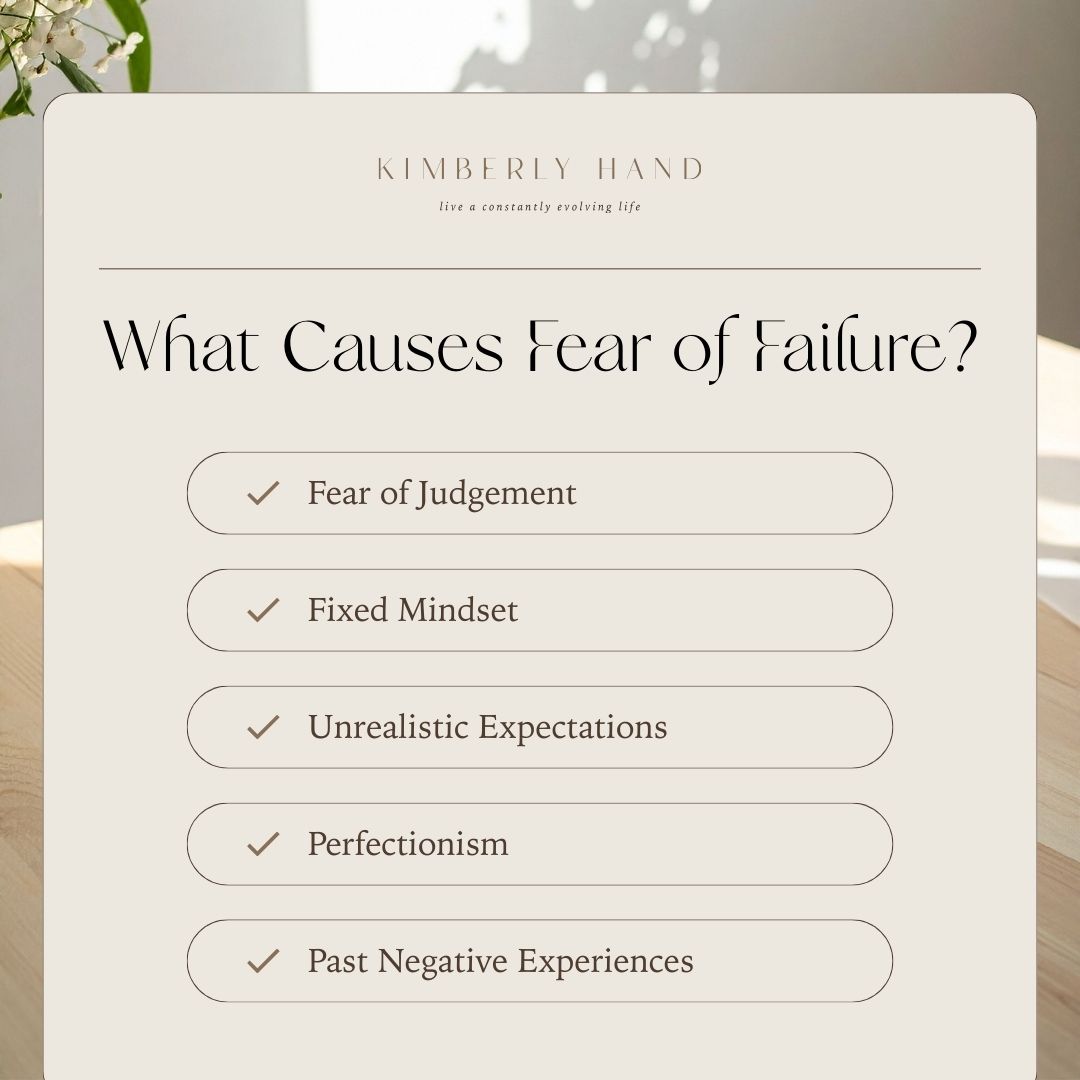
What Causes Fear of Failure?
Fear of Judgement
Half the time, it’s not even the failing part… It’s the “what are people going to think?” part. You know you can do the thing, but the idea of messing up in front of others makes you hesitate. That fear of looking silly or feeling like you aren’t enough can be louder than anything else.
But honestly, most people aren’t watching as closely as it feels like they are. Everyone’s kind of wrapped up in their own stuff. And the more you just do things anyway—even small things—you start to care a bit less about the outside noise.
Fixed Mindset
If you believe you either “have it or you don’t,” then failure will always feel a little personal. It’s not just “that didn’t work.” Instead, it turns into “maybe I’m just not good at this,” which is a much heavier feeling.
However, when you start seeing skills as something you build over time, it softens that burden a bit. It’s less about proving yourself and more about figuring things out as you go.
Unrealistic Expectations
Sometimes we set the bar so high that there’s almost no room to move. It sounds motivating at first, but it can backfire quickly. One small slip and it feels like everything’s gone wrong. Breaking things down helps more than people expect. Smaller steps, smaller wins… it makes the whole thing feel doable instead of overwhelming.
Perfectionism
This one’s sneaky because, on the surface, perfectionism looks like a good thing. But a lot of the time, it’s actually fear in disguise. You don’t want to get it wrong, so you keep tweaking, delaying, overthinking… Letting things be a bit messy, a bit “not perfect,” can actually get you moving again. Progress over perfection sounds simple, but it really does take the pressure off.
Past Negative Experiences
Old stuff sticks. Even if you think you’re over it, it can still show up in how you approach new situations, experiences, and tribulations. You hesitate more, second-guess frequently, play it safer than you normally would. A lot of that is just your brain trying to protect you, even if it’s not that helpful anymore. Once you notice it, you can start to separate “that was then” from “this is now”… and give yourself a bit more room to try again.
Related: How to Rewire Your Brain for Lasting Change
Is Fear of Failure a Weakness?
Here’s a truth bomb: fear of failure isn’t a weakness… It’s a normal reaction to uncertainty and risk. In fact, it can be helpful! That fear can help you prepare more thoughtfully, plan better, and consider your steps more carefully. The trick is learning to work with it instead of letting it block you. It only becomes a problem if it keeps you from acting.
How Does Fear of Failure Affect Success?
Lower Resilience
A strong fear of failure can make setbacks feel catastrophic when they happen. You might want to give up quickly or take criticism personally. However, building resilience means learning to respond rather than react. It also means going headfirst into new obstacles. Reflection, support, and practice help you recover faster and see setbacks as helpful information, not judgment.
Reduced Creativity
Fear doesn’t just block action—it blocks imagination. Feeling afraid to fail makes experimenting or trying new ideas feel risky, leading to avoidance. Creativity thrives on trial, error, and iteration, so avoiding that risk can stop growth right in its tracks. Practicing small, low-stakes experiments allows you to expand your thinking while keeping fear manageable. It’s essentially exposure therapy!
Sometimes, the best lessons come from watching others push themselves. Ep. 88 – Pushing Limits and Overcoming Fear with the Python Cowboy is literally wild. We recap my experience of going python hunting in the Everglades, totally outside my comfort zone. You can imagine the fear, the adrenaline, the “Oh my gosh, I can’t do this” moments. And yet, I came out empowered. That’s what taking action despite fear feels like. And you can do it too!
Procrastination
Ever catch yourself saying “I’ll start tomorrow” because you’re worried about failing? That’s fear in action. Procrastination gives temporary comfort, but it doesn’t reduce the underlying anxiety. A helpful tactic is to break tasks into tiny, concrete steps. Starting is often the hardest part, and momentum builds once you take that first move.
Avoidance of Opportunities
Fear of failure often makes us say “no” before we even try. That might look like skipping a promotion, avoiding a side project, or not pitching your idea because you’re filled with worry. And the more we avoid, the smaller our world feels—which only reinforces the fear. One approach is to intentionally lean into discomfort in small ways. Over time, taking action becomes easier and less scary.
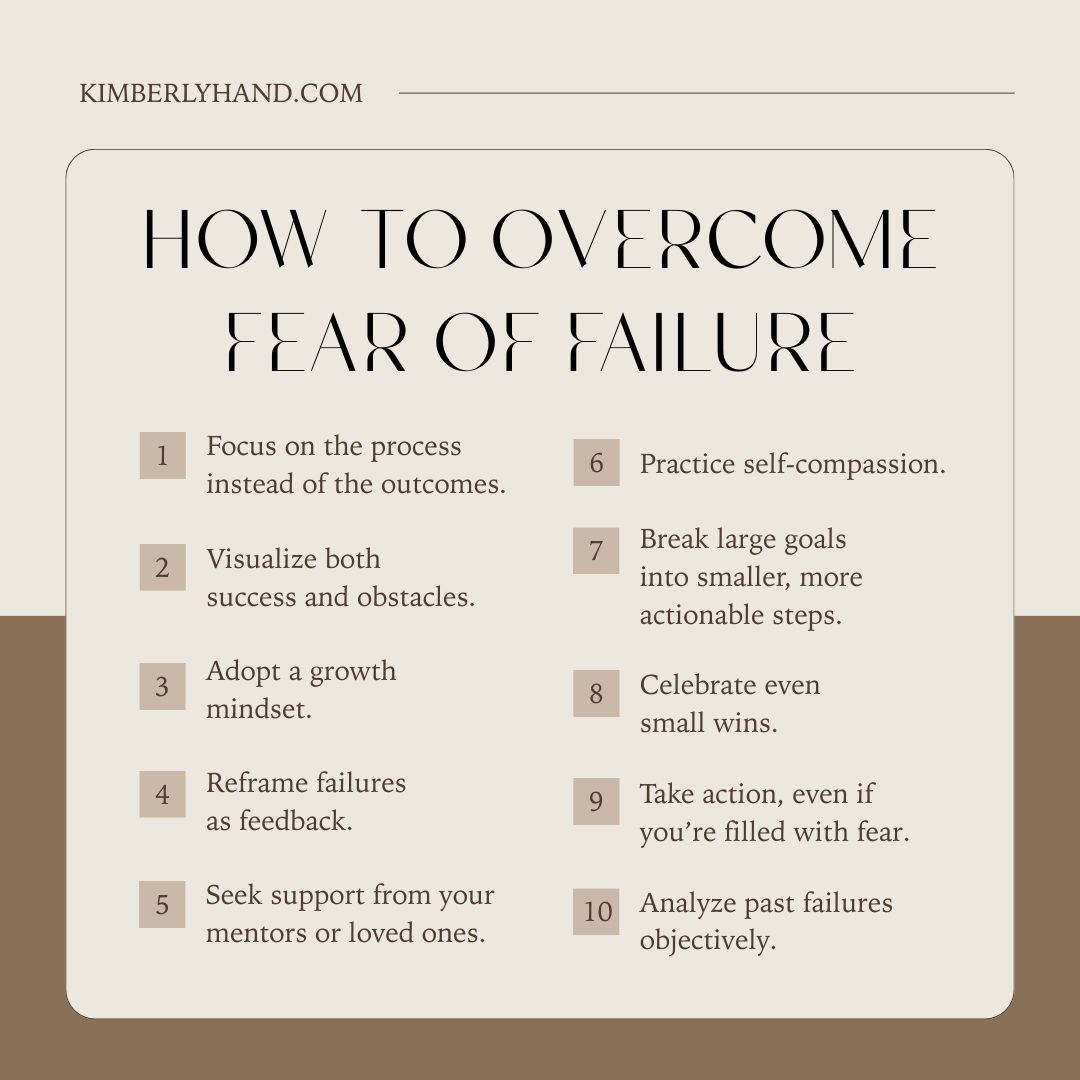
How to Overcome Fear of Failure
Focus on the process instead of the outcomes.
Results are great… but they’re not the whole story. When you shift your attention to showing up, practicing, and learning as you go, the pressure eases a bit. You’re not waiting on a big end result to feel like you’re doing well—you’re noticing progress as it happens. And that alone takes some of the power out of fear.
Visualize both success and obstacles.
Only picturing the win can feel a bit disconnected from reality. It helps to also imagine what might go wrong… and how you’d handle it. That way, when something does pop up, it doesn’t throw you off as much. You’ve already “been there” in your head, and you know you can work through it.
Adopt a growth mindset.
There’s a big difference between trying to prove yourself and being willing to learn. When you lean into learning, things loosen up. Mistakes aren’t this big, heavy thing anymore—they’re just part of the process. You start to see each attempt as useful, even when it doesn’t go to plan.
If you’re interested in expanding on this, listen to my episode, “Creating Positive Changes with Rocco Crapis.” In it, Rocco and I discuss resilience, mental health, personal growth, and the transformation of negative thought patterns. It’s beautifully inspiring!
Reframe failures as feedback.
Instead of seeing failure as a full stop, treat it as powerful information. What worked? What didn’t? And what would you do differently next time? Taking a step back like this makes it feel less personal… and a lot more useful.
Seek support from your mentors or loved ones.
Talking things through really does help… more than you might expect. A different perspective, a bit of encouragement, or even just being heard can take the edge off. It’s also a reminder that you’re not the only one who feels this way sometimes.
Practice self-compassion.
This one matters, especially when things don’t go as planned. It’s easy to be hard on yourself, but it doesn’t actually help you move forward. Try speaking to yourself the way you would to someone you care about—steady, patient, and on your side.
If you need a gentle nudge of encouragement, listen to “Become Unstoppable: Rewiring Your Subconscious Mind with Hypnotherapist Christina L. Woods.” Internationally recognized and immensely informative, Christina talks to me about all things imposter syndrome, self-sabotage, and burnout.
Break large goals into smaller, more actionable steps.
Big goals can feel like a lot… which is usually when fear kicks in. Breaking things down makes it all more doable. One small step at a time feels manageable, and those small wins start to build momentum before you even realise it.
Celebrate even small wins.
It doesn’t have to be a huge milestone to count. Starting something, finishing a task, putting yourself out there… it all adds up. When you actually pause and acknowledge those moments, confidence builds naturally. And fear? It tends to shrink in the background.
And sometimes celebrating small wins is what shifts your perspective, like Ep. 104 – Celebrating 2 Years of The Cinnamon Effect, where recognizing growth in small steps transforms fear into forward movement.
Take action, even if you’re filled with fear.
Fear doesn’t always go away… and that’s normal. The real shift happens when you stop waiting for it to disappear and start moving anyway. Each time you do, you prove to yourself that it doesn’t get the final say.
The epitome of taking action despite fear is highlighted in Ep. 7 – A Deep Dive Into Being Fearless with Spearfishing Champion Summer Sawaya. Summer shares what it takes to become a trailblazer in her sport—fear included. You’ll notice how preparation, practice, and mindset turn fear into fuel.
Fear of failure can be something that guides you, not blocks you!
The big takeaway here… fear of failure isn’t really the enemy it gets made out to be. It’s more like a signal, a quiet nudge that whatever you’re facing actually matters to you. It still shows up, of course, but when you start moving anyway—even in small, slightly uncomfortable steps—you begin to realize it doesn’t have as much control as it once did. Over time, that builds a steadiness you can feel, and things start opening up in ways that didn’t seem possible before.
So yes, fear will be there… just not running the show. You can meet it with a step forward, however small that step is on the day. Keep showing up, keep it consistent, and be kind to yourself in the process… that part matters more than you think. If you want a place to track that progress, you can use The Cinnamon Effect Journal or dip into The Cinnamon Effect for a bit of extra perspective along the way.
Finally, reflecting authentically matters. Ep. 48 – Evolving Authentically Through Life’s Ups and Downs reminds us that challenges and setbacks aren’t a signal to stop. They’re opportunities to get stronger and more resilient. And you’re absolutely capable of it…


