
Showing up for yourself sounds simple… but if you really think about it, it’s one of those things that quietly shapes everything. Your confidence, your mental well-being, the way you make decisions, even how much you trust yourself day to day. When you’re actually showing up for yourself, life feels a bit more aligned than usual. You begin to feel like you have your own back.
But when you’re not showing up for yourself, it can slip the other way pretty quickly. You start putting yourself last, saying yes when you don’t want to (hello, people pleasing), or telling yourself you “don’t deserve” rest, time, or follow-through. And over time, that adds up.
In “Ep. 124 – Dance As A Wellness Hack And Parenting Kids By Showing Up For Yourself with Peter Robbins,” there’s this really honest conversation about doing things that feel uncomfortable. When you just show up, even imperfectly, you slowly begin to build confidence.
So today, we’re getting into how to show up for yourself in a way that actually feels doable, not overwhelming. I’ll tell you what it means to show up for yourself, why it can feel so hard, and offer actionable tips that you can start using today. It doesn’t have to be hard; you just need the right tools.

How to Show Up for Yourself Even on Hard Days
A lot of people want to show up for themselves, they just find it hard to keep it consistent. And it makes sense. Life gets busy, things pile up, and other people’s needs can feel more urgent than your own.
But showing up for yourself isn’t about changing everything overnight or becoming a completely different person. It’s usually much smaller (and simpler!) than that. You choose, again and again, to do things that truly support you. Think: setting a boundary, taking a break when you need it, and following through on something you said you’d do.
And over time, those small choices start to add up. They build a kind of self-trust that actually sticks.
What Does It Mean to Show Up for Yourself?
Showing up for yourself means honoring your needs, prioritizing your values, considering your mental health, and acting as your own ally.
It’s keeping the promises you make to yourself and setting boundaries instead of defaulting to people-pleasing. Showing up for yourself is also about being honest when something isn’t working, instead of avoiding it. And sometimes, it’s sitting with uncomfortable emotions instead of distracting yourself from them.
In “Ep. 94 – Breaking Generational Trauma and Negative Thought Patterns,” there’s a really important point about not bypassing what you feel. Because if you keep ignoring those signals, it becomes harder to trust yourself over time.
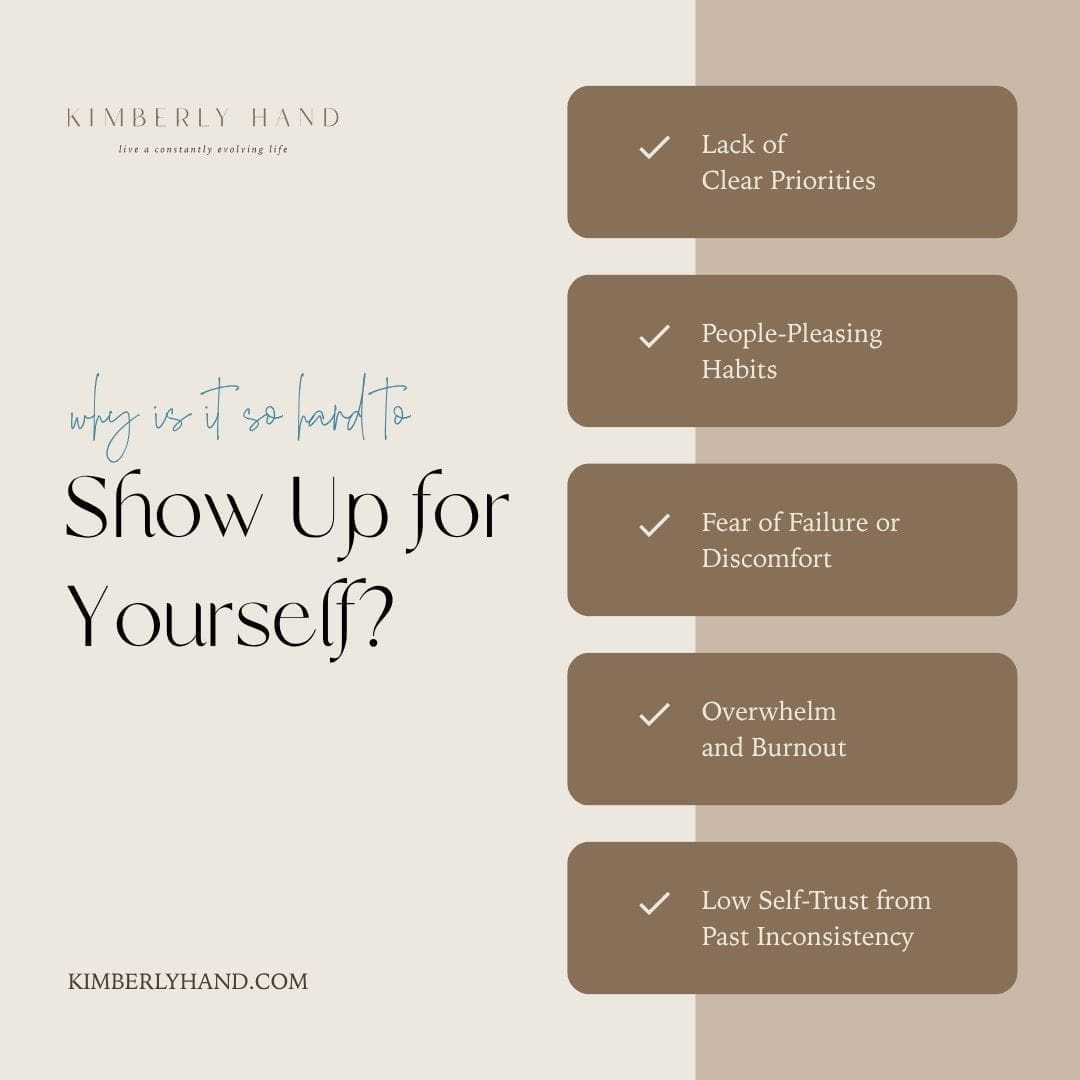
Why Is It So Hard to Show Up for Yourself?
Lack of Clear Priorities
If you’re not sure what actually matters to you, it’s really easy to default to whatever feels urgent at the moment. And that’s usually other people’s needs. Getting clear on your priorities makes it easier to choose yourself without second-guessing it. Without that clarity, your energy gets pulled in too many directions, and you end up living reactively instead of intentionally.
People-Pleasing Habits
If you’re used to people-pleasing, showing up for yourself can feel… honestly, kind of wrong at first. Like you’re being selfish. But you’re actually not. You’re just shifting out of patterns that taught you that your needs came second.
That discomfort isn’t a sign you’re doing something wrong, but a sign you’re doing something new. Over time, choosing yourself becomes less about guilt and more about self-respect.
Learn more about mom guilt and why it’s so common.
Fear of Failure or Discomfort
Showing up for yourself often means doing things that feel uncomfortable, like having hard conversations, trying something new, or risking getting it wrong. So instead, it can feel easier to avoid it altogether. But avoidance usually leads to the exact feeling you were trying to escape.
Growth rarely feels smooth in the moment, it feels uncertain, vulnerable, and, sometimes, inconvenient. But when you begin to see discomfort as part of the process, it becomes easier to move through it.
Overwhelm and Burnout
When you’re already exhausted, even simple things can feel like too much. In “Ep. 110 – Navigating Wellness: Insights from the Eudemonia Summit,” there’s a strong reminder that burnout isn’t just physical, it’s mental too. And sometimes, showing up for yourself actually starts with rest.
Remember: showing up for yourself doesn’t always have to look productive. It can also look like slowing down, creating space, and allowing your nervous system to reset.
Low Self-Trust from Past Inconsistency
If you’ve told yourself “I’ll start Monday” or “I’ll do it tomorrow” a hundred times… It’s normal to stop believing in yourself. That doesn’t mean you can’t rebuild that trust; it just means you need to start smaller.
Don’t take this as a sign of failure. Self-trust isn’t built through big promises! You build it through small, consistent follow-through.
Signs You Are Not Showing Up for Yourself
Sometimes you can put yourself last without even realizing it… Here are some of the signs that you’re not showing up for yourself:
- Constantly putting others first at your own expense
- Avoiding decisions or difficult conversations
- Ignoring burnout or stress signals
- Starting goals but not following through
- Negative self-talk or feeling like you “don’t deserve” better
These aren’t fixed traits. In fact, they’re just a sign that your priorities need a little shifting! And there are plenty of easy, practical ways to do so. Here’s exactly how to show up for yourself everyday:
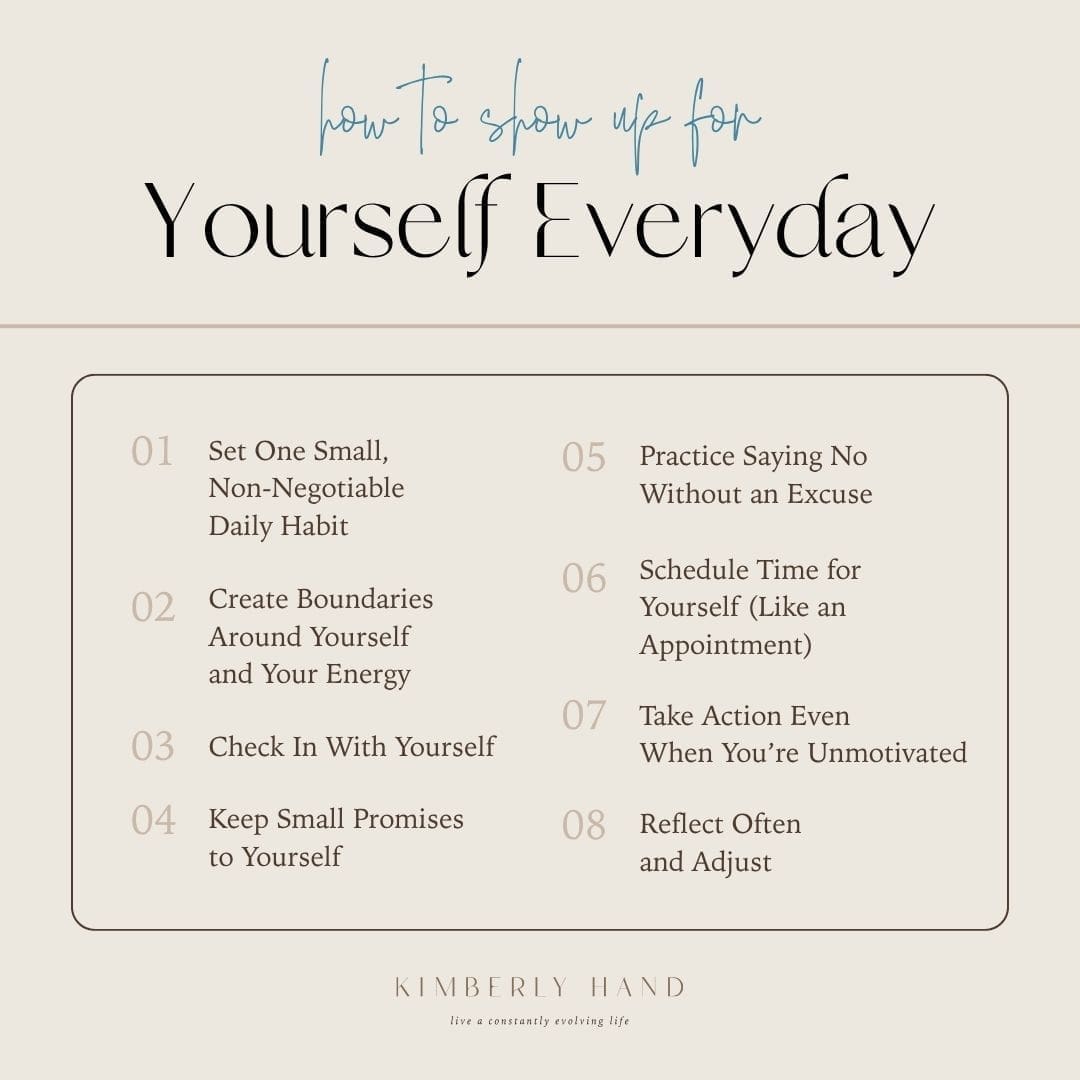
How to Show Up for Yourself Everyday
Set One Small, Non-Negotiable Daily Habit
Start small. Like, really small. Set one small habit you commit to no matter what. Maybe it’s a walk, journaling with The Cinnamon Effect Journal, or even just taking a moment to pause.
If you’re unsure of what this looks like in practice, listen to “Ep. 76 – Food, Movement, Longevity and Being Your Own Cure with Wellness Entrepreneur Asha Walker.” Our conversation centers on how simple daily habits lay the foundation for long-term health. While the subjects differ, the same framework applies here.
Create Boundaries Around Yourself and Your Energy
Okay, I get it. Setting boundaries can feel uncomfortable at first… but I promise you, they’re necessary. You don’t have unlimited time or energy, and protecting that is part of showing up for yourself. You’ll get there!
When you stop putting others’ needs before your own, you begin to better understand what actually drains you… versus what supports you. Boundaries aren’t about shutting people out. Instead, they’re about creating space for what truly encourages and lifts you up.
For help with this, listen to “Ep. 34 – Know Your Worth and Build Your Emotional Health with Relationship Expert Alexia McLeod.”
Check In With Yourself
Checking in with yourself is a big part of showing up for yourself in general. Even just a quick moment: How am I feeling? What do I need today? That awareness helps you make better choices instead of running on autopilot 24/7.
This doesn’t have to be a complicated, time-consuming process. It can be a pause between tasks, a quiet moment in the morning, or even a brief mental reset. The goal isn’t perfection; it’s presence.
Keep Small Promises to Yourself
Keeping promises to yourself is where self-trust starts. Not with big goals, but with tiny follow-through moments that matter. You said you’d do it, so you do it. Even if it’s inconvenient or you “don’t feel like it.”
These small moments build something bigger over time. Every time you follow through, you reinforce the idea that you can rely on yourself. And that consistency is what builds lasting change.
Practice Saying No Without an Excuse
This one will sound hard at first, but I promise you’ll get used to it. You don’t need a long reason to say no. You don’t need to justify everything. A simple “no” is enough. And the more you practice it, the easier it gets.
Saying “no” isn’t about being dismissive. Instead, it’s about being intentional with your time. When you stop over-explaining, you can start to trust that your boundaries can stand on their own.
Schedule Time for Yourself (Like an Appointment)
If it’s not scheduled, it usually doesn’t happen. Treat your time the same way you would anything important, because it is. You don’t have to have big blocks of scheduled time down to the minute, but make an effort to set aside some time for yourself during the day.
Even small, protected pockets of time can make a difference. It’s less about how much you have, and more about what you do with it. And how consistently you show up!
Take Action Even When You’re Unmotivated
It can be hard to take the first step towards action, especially when motivation isn’t at its peak. But honestly, motivation comes and goes. It’s action that truly builds momentum. In “Ep. 104 – Celebrating 2 Years of The Cinnamon Effect – Cutting the Noise and Saying Yes Life!,” there’s this idea of saying yes to life, even when it feels uncomfortable, and it really ties into this.
I know how intimidating this may sound… but you don’t need to feel ready. You just need to begin. More often than not, the act of starting is what creates the energy you were waiting for. Progress doesn’t come from perfect timing, it comes from the willingness to move forward.
Reflect Often and Adjust
At the end of every week, take the time to sit down and truly be with yourself. Look at your current daily routine. What’s working or not working? You don’t need to get it perfect straight away; you just need to keep adjusting as you go.
Reflection gives you the opportunity to stay aligned instead of stuck. When you regularly check in and make small shifts, you create a rhythm that evolves with you, not one that holds you back.
Practical Ways of Showing Up for Yourself
Now it’s time to put this blog post into action. Here are some of the best ways you can show up for yourself, beginning now!
- Choosing rest instead of overworking
- Going to the gym even when you don’t feel like it
- Choosing yourself over other people when needed
- Having a difficult conversation instead of avoiding it
- Sticking to a routine, even when it’s not exciting
- Prioritizing your mental health
- Saying “no” when it feels right, even if others don’t like it
You might also find it helpful to anchor yourself with something simple like a mantra. If you haven’t explored that yet, this is a really good place to start: What Is a Personal Mantra?
And even your environment plays a role here. In “Ep. 51 – Transform Your Home Into a Wellness Sanctuary: How Intentional Design Can Change Your Life,” there’s a reminder that your space can either support you or drain you. Small changes there can make showing up for yourself feel easier.
Showing up for yourself isn’t about suddenly becoming a completely different person or overhauling your life overnight… It’s much simpler than that.
At the end of the day, this isn’t about doing everything right. It’s about choosing yourself in small ways that feel simple, honest, and repeatable. Even when you don’t feel like it or when it’s inconvenient.
Because over time… that’s what builds real confidence. Not big leaps, just consistency. If you liked this post, you might also want to read my guide for finding joy in life through simple habits. If you want to go deeper into more conversations like this, head to The Cinnamon Effect podcast. See you there!


